
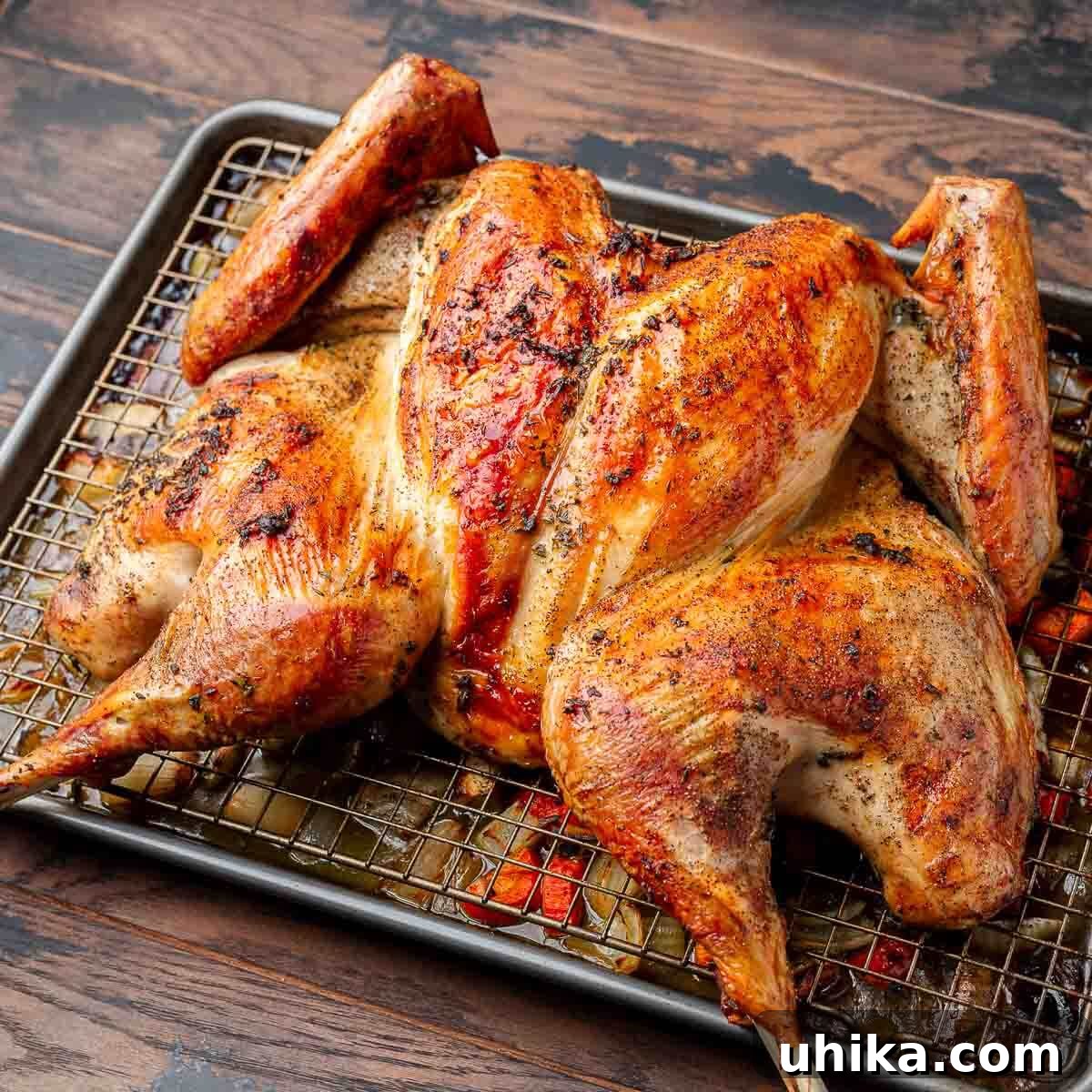
Say goodbye to dry, unevenly cooked holiday birds! This comprehensive guide to a roast spatchcock turkey unlocks the secret to consistently tender, juicy meat, remarkably crisp skin, and an astonishingly fast cooking time. Perfect for busy holiday hosts, this method will revolutionize your festive meal preparation and ensure a show-stopping centerpiece for your table.
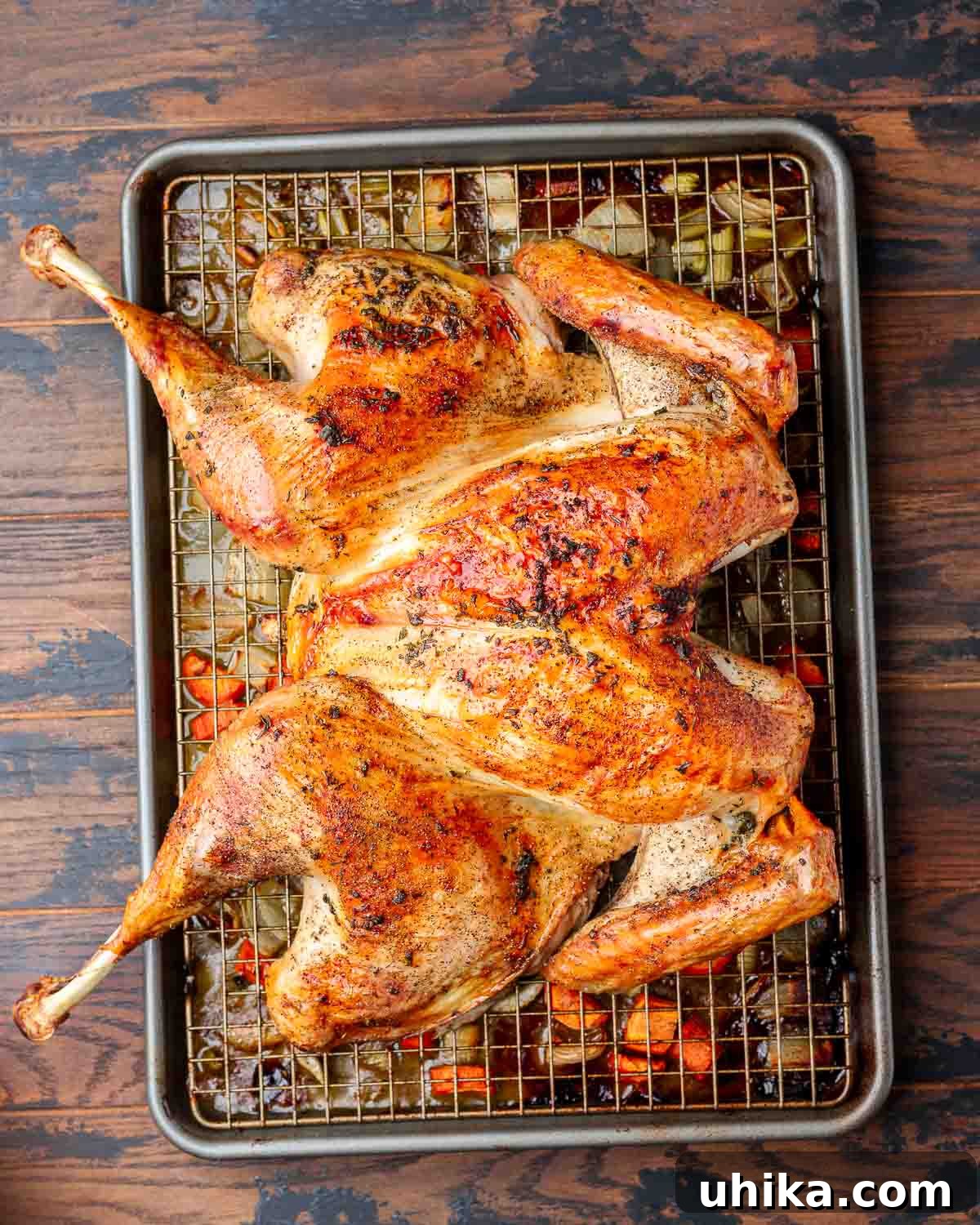
Master the Art of Spatchcocking for a Perfect Holiday Turkey
The holiday season often brings with it the delightful challenge of orchestrating a grand feast, often battling limited oven space and a ticking clock. If you’ve ever wished for a culinary “cheat code” to simplify your Thanksgiving or Christmas dinner, then look no further than the spatchcock turkey. This innovative roasting technique not only saves you precious time but also guarantees superior results, making it an indispensable skill for any home cook.
So, what exactly does “spatchcock” mean? At its core, spatchcocking—also known as butterflying—involves removing the backbone of a bird, allowing it to be flattened. This simple yet transformative preparation method ensures that the turkey lies flat on a baking sheet, exposing all parts of the bird to consistent heat. The result? Every inch of your turkey cooks evenly, eliminating the common dilemma of overcooked breast meat and undercooked dark meat.
The advantages of a flattened turkey are manifold. Beyond achieving unparalleled evenness, you’ll discover significantly reduced cooking times compared to traditional roasting. This efficiency is a game-changer, freeing up your oven for other beloved holiday sides like a creamy sweet potato casserole, fluffy garlic butter dinner rolls, or a vibrant green bean almondine. Furthermore, the increased surface area exposed to direct heat leads to unbelievably crispy skin – a golden, crackling exterior that everyone will fight for – while locking in moisture for ultra-juicy, succulent meat throughout.
As an added bonus, this spatchcock turkey recipe naturally produces an abundance of rich, flavorful pan drippings. These savory juices are the foundation for the best homemade gravy, providing a depth of flavor that complements your turkey perfectly. We even have a fantastic recipe for giblet gravy that utilizes these precious drippings, ensuring no flavor goes to waste.
Table of Contents
- Recipe Ingredients
- How to Make a Spatchcock Turkey
- Top Tips for Success
- Frequently Asked Questions
- More Thanksgiving Favorites
- Spatchcock Turkey Recipe
Essential Spatchcock Turkey Recipe Ingredients
Crafting the perfect spatchcock turkey begins with selecting high-quality ingredients. Below, you’ll find a detailed list of what you’ll need, along with important notes to guide your preparation. Each component plays a vital role in achieving that coveted moist interior and irresistibly crisp skin.
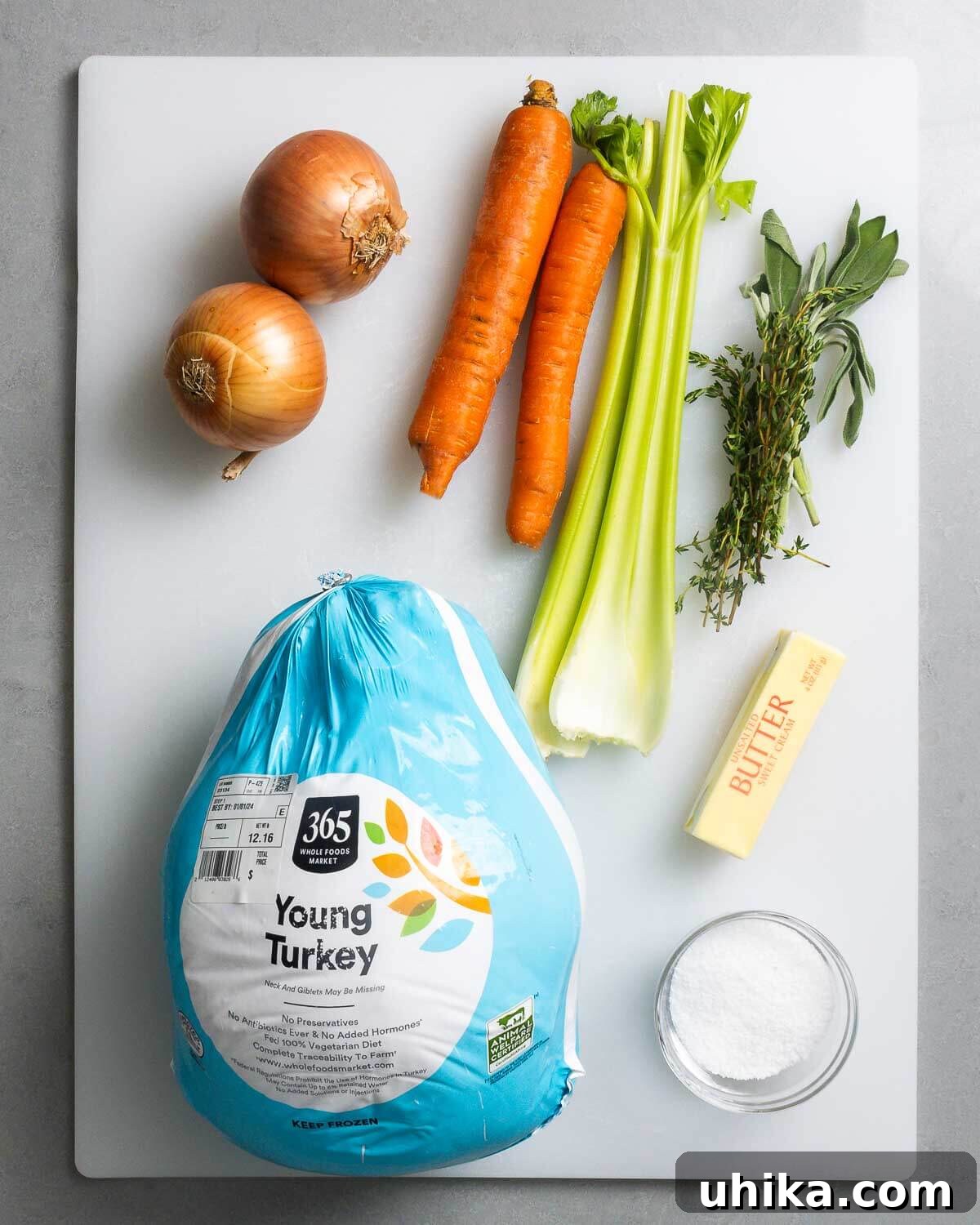
- Whole Turkey: For optimal results, we highly recommend a natural or organic turkey, ideally around 12 pounds. Crucially, choose a turkey with no added salt or preservatives. This allows you to control the seasoning precisely during the dry brining process, preventing an overly salty final product. If you’re working with a frozen turkey, remember to account for adequate thawing time; refer to our FAQ section below for thawing guidelines.
- Kosher Salt (for the dry brine): Dry brining is a non-negotiable step for a truly juicy and flavorful turkey. The key is to use a 1-1.25% salt ratio relative to your turkey’s weight. The amount of tablespoons you’ll need varies significantly by brand due to differences in crystal size and density. For instance, if using Diamond Crystal Kosher Salt, you’ll need approximately 6 tablespoons for a 12-pound bird. If using Morton’s Kosher Salt, which is denser, you’ll require about 4 tablespoons for the same weight.
- Aromatic Vegetables (Carrots, Celery, and Onion): These humble vegetables form the flavor base for your pan drippings. Placed at the bottom of the roasting pan, they elevate the drippings with their earthy sweetness and prevent them from burning. After roasting, these veggies and drippings can be strained and transformed into a phenomenal gravy.
- Fresh Herbs (Sage and Thyme): Fresh herbs are essential for infusing our herb butter with fragrant, classic holiday flavors. Finely chopped fresh thyme and sage are mixed into softened butter, which is then massaged all over and under the turkey skin, imparting an incredible aroma and taste.
- Unsalted Butter: The unsalted butter forms the rich base for our herb butter. Using unsalted butter allows you to control the overall saltiness of the turkey, especially after the dry brining process. Ensure it’s softened to room temperature for easy mixing and spreading.
For precise measurements and detailed instructions, please consult the full recipe card below.
How to Make a Spatchcock Turkey: A Step-by-Step Guide
Transforming a whole turkey into a perfectly roasted spatchcock masterpiece is simpler than you might think. Follow these detailed steps to achieve an impressive and delicious result with ease.
- Prepare the Turkey for Spatchcocking: Begin by placing your approximately 12-pound turkey breast-side down on a large, sturdy cutting board, with the tail end facing you. Using paper towels, thoroughly pat the turkey dry. This step is crucial for achieving crispy skin. Now, locate the backbone. Using a sharp pair of heavy-duty kitchen shears, start cutting alongside one side of the backbone, working your way from the tail end up towards the neck. If you plan to make giblet gravy, remember to remove the giblets and neck from the cavity and set them aside. (See Photo #1 in the collage below)
- Remove the Backbone: Continue your cut all the way to the neck, ensuring the backbone is completely detached on one side. Repeat this process on the other side of the backbone until it is fully removed from the turkey. You can trim away any loose, overhanging skin around the neck opening for a cleaner presentation. Don’t discard the backbone; it, along with the giblets, is excellent for making flavorful gravy or turkey stock. (See Photo #2 and #3 in the collage below)
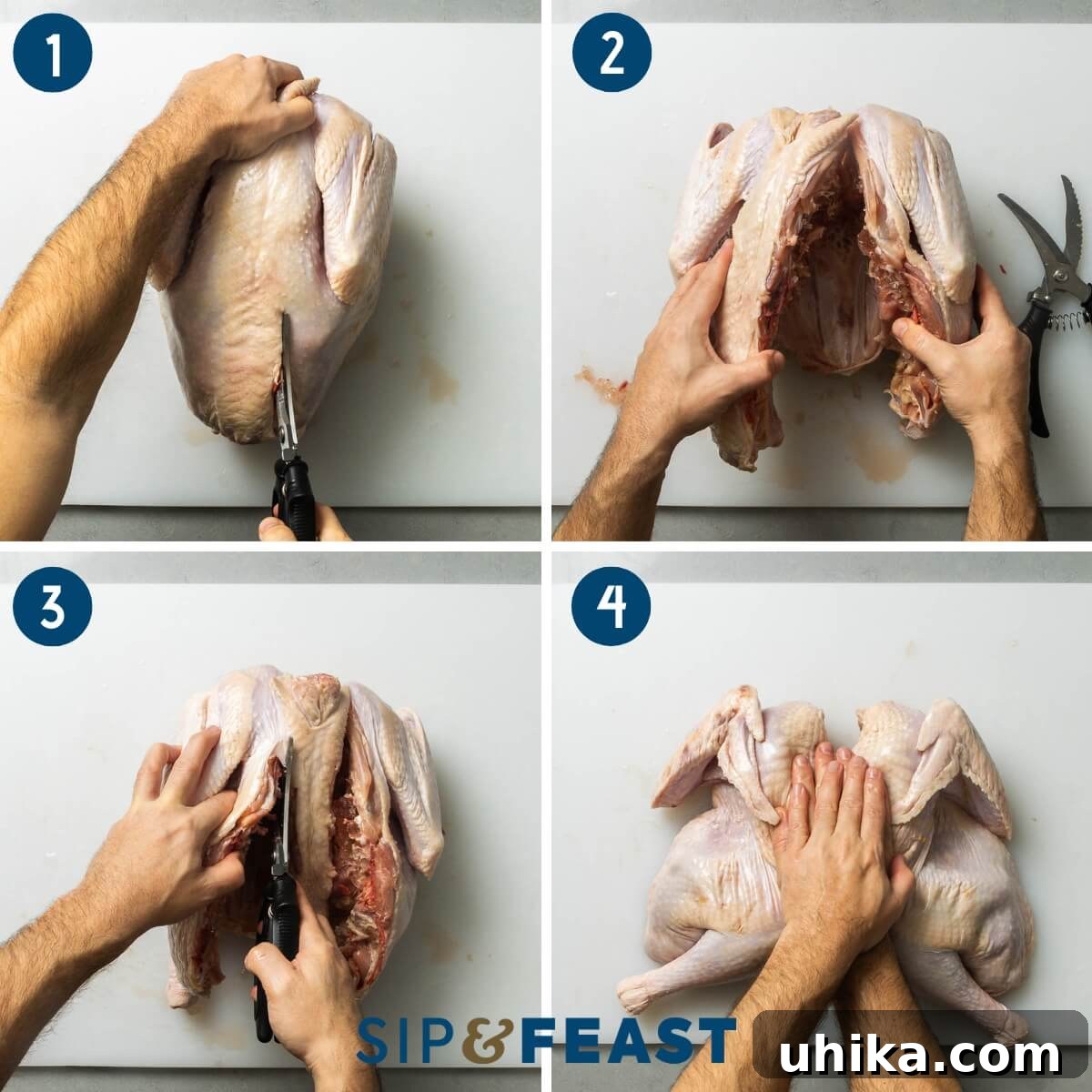
- Flatten the Turkey: Flip the turkey over so the breast side is now facing up. Using both hands, firmly press down on the breastbone until you hear a few cracks and the turkey lies flat. The goal here is to evenly splay or flatten the bird, ensuring consistent thickness across the breast and legs for uniform cooking. This creates the signature spatchcock shape. (See Photo #4 in the collage above)
- Dry Brine Overnight: Transfer the flattened turkey to a clean baking sheet. Now, it’s time for the dry brine. If using Diamond Crystal Kosher salt, sprinkle about 6 tablespoons generously over the entire turkey, both on the skin side and underneath, trying to get some under the skin where possible. If using Morton’s Kosher salt, use about 4 tablespoons. Don’t worry about using every single grain of salt, just ensure all surfaces of the turkey are well-coated. Refrigerate the turkey uncovered overnight (or for at least 8-12 hours). This allows the skin to dry out, leading to incredible crispness, and the salt to penetrate the meat, resulting in a supremely juicy bird. (See Photo #5 in the collage below)
- Prepare for Roasting: The next day, remove the dry-brined turkey from the refrigerator at least 1 hour before you plan to roast it, allowing it to come closer to room temperature for more even cooking. While the turkey rests, soften 8 tablespoons of unsalted butter at room temperature. Preheat your oven to a high temperature of 450°F (232°C) and adjust your oven rack to the middle position. On a large baking sheet, spread out the chopped aromatics: 2 large carrots, 3 ribs of celery, and 2 large onions. Place a wire rack directly on top of these vegetables. These vegetables will not only infuse the pan drippings with flavor but also prevent them from burning during the high-heat roasting process. Alternatively, you can omit the vegetables and add 8-12 ounces of water to the bottom of the pan to achieve the same burning prevention. (See Photo #6 in the collage below)
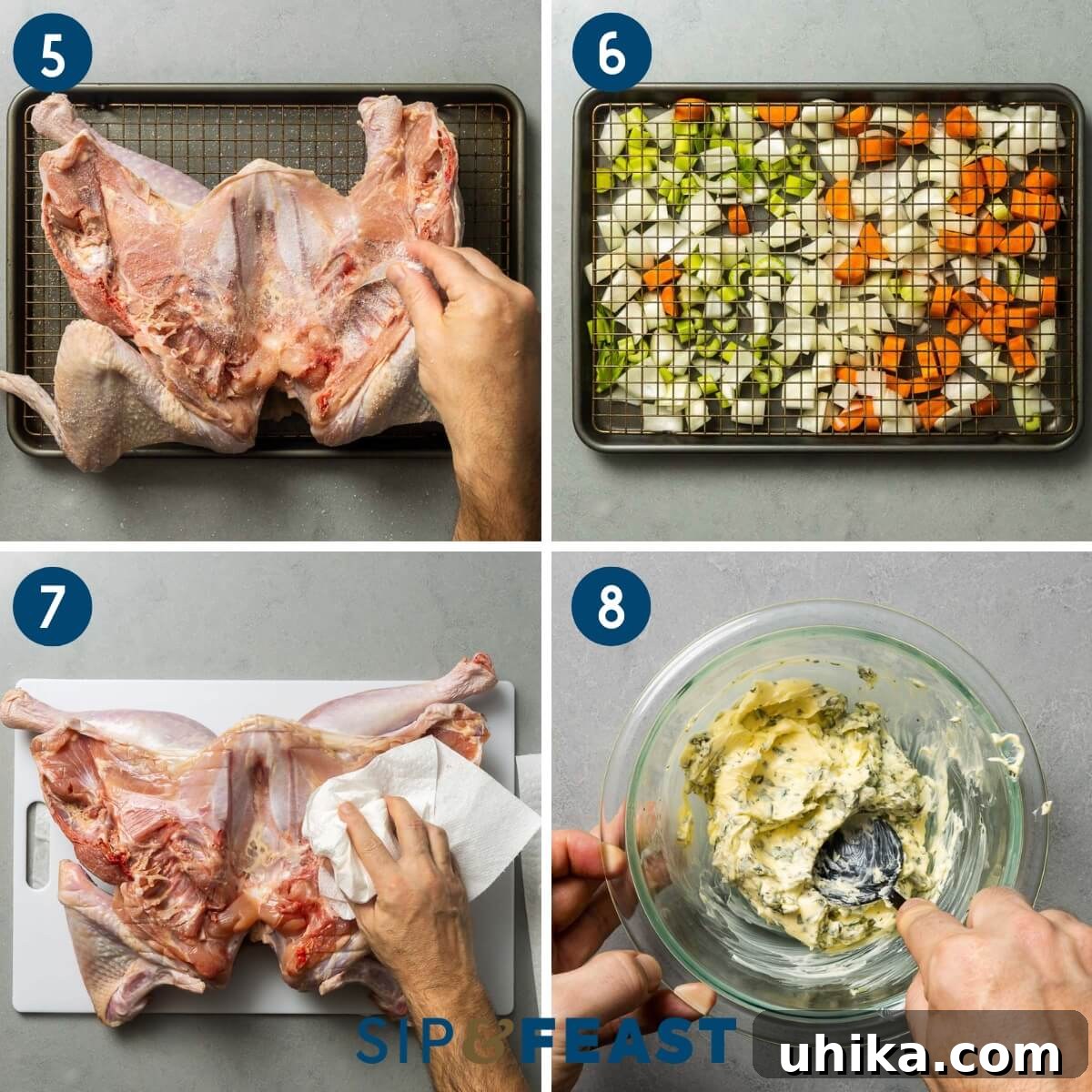
- Season and Butter the Turkey: Once the turkey has rested, thoroughly pat it dry again with paper towels, removing any residual moisture from the brining process. Season generously with about 2 teaspoons of freshly ground black pepper. Carefully place the turkey on the wire rack, positioning it over the bed of vegetables. Tuck the wing tips underneath the turkey to prevent them from burning during roasting. (See Photo #7 in the collage above)
- Make the Herb Butter: In a small bowl, combine the softened unsalted butter with 10 minced large sage leaves and 1 tablespoon of fresh thyme leaves. Mix thoroughly until a smooth, fragrant paste forms. (See Photo #8 in the collage above)
- Apply Herb Butter and Insert Thermometer: Generously spread the prepared herb butter all over the turkey, paying special attention to getting it under the skin wherever possible. This ensures maximum flavor and helps achieve that incredibly crisp skin. Insert a probe thermometer into the thickest part of the turkey breast, ensuring it doesn’t touch any bone. Set the alarm to sound when the internal temperature reaches 150°F (66°C). (See Photo #9 in the collage below)
- Roast to Perfection: Place the prepared turkey in the preheated 450°F (232°C) oven. Roast, rotating the pan 180 degrees halfway through the cooking time to ensure even browning. A 12-pound turkey typically takes around 75-90 minutes to cook. For example, if your turkey takes 77 minutes, you would rotate the pan at approximately 38-40 minutes. Remove the turkey from the oven once the thermometer alarm signals 150°F (66°C).
- Rest the Turkey: Immediately upon removing the turkey from the oven, loosely tent it with aluminum foil and allow it to rest undisturbed for at least 30 minutes. This crucial resting period allows the juices to redistribute throughout the meat, ensuring maximum tenderness and flavor. During this time, the internal temperature will continue to climb, reaching the safe serving temperature of approximately 165°F (74°C). (See Photo #10 in the collage below)
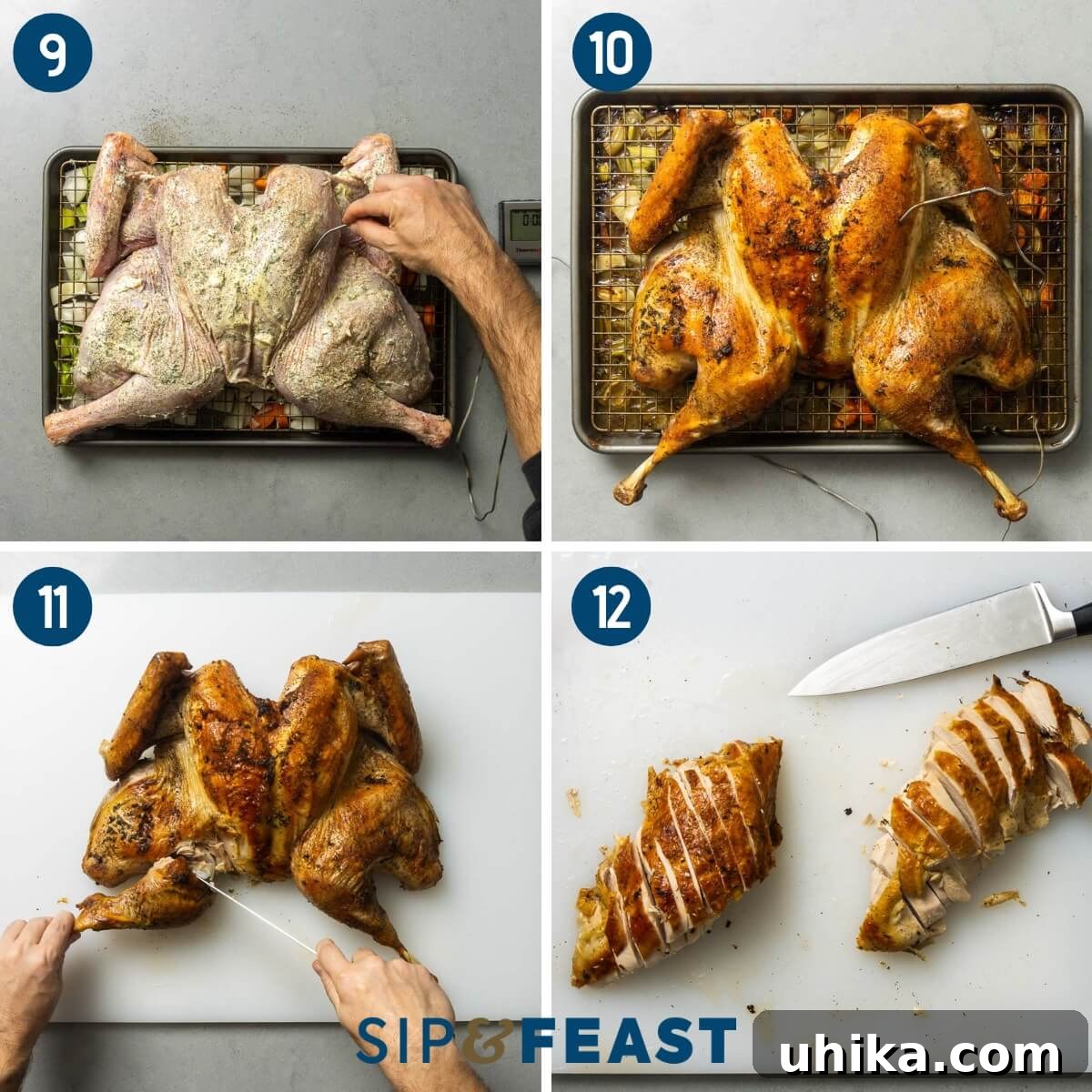
- Carve and Serve: After the turkey has rested and reached 165°F (74°C), it’s time to carve. Start by removing the legs and thighs, then proceed to carve the breast and wings. If you or your guests prefer darker meat to be exceptionally tender, you can optionally return the carved dark meat (thighs and legs) to the oven and cook them until they reach an internal temperature of 185-190°F (85-88°C). While the dark meat finishes cooking, keep the white meat loosely tented with foil to maintain its warmth and juiciness. (See Photo #11 in the collage above)
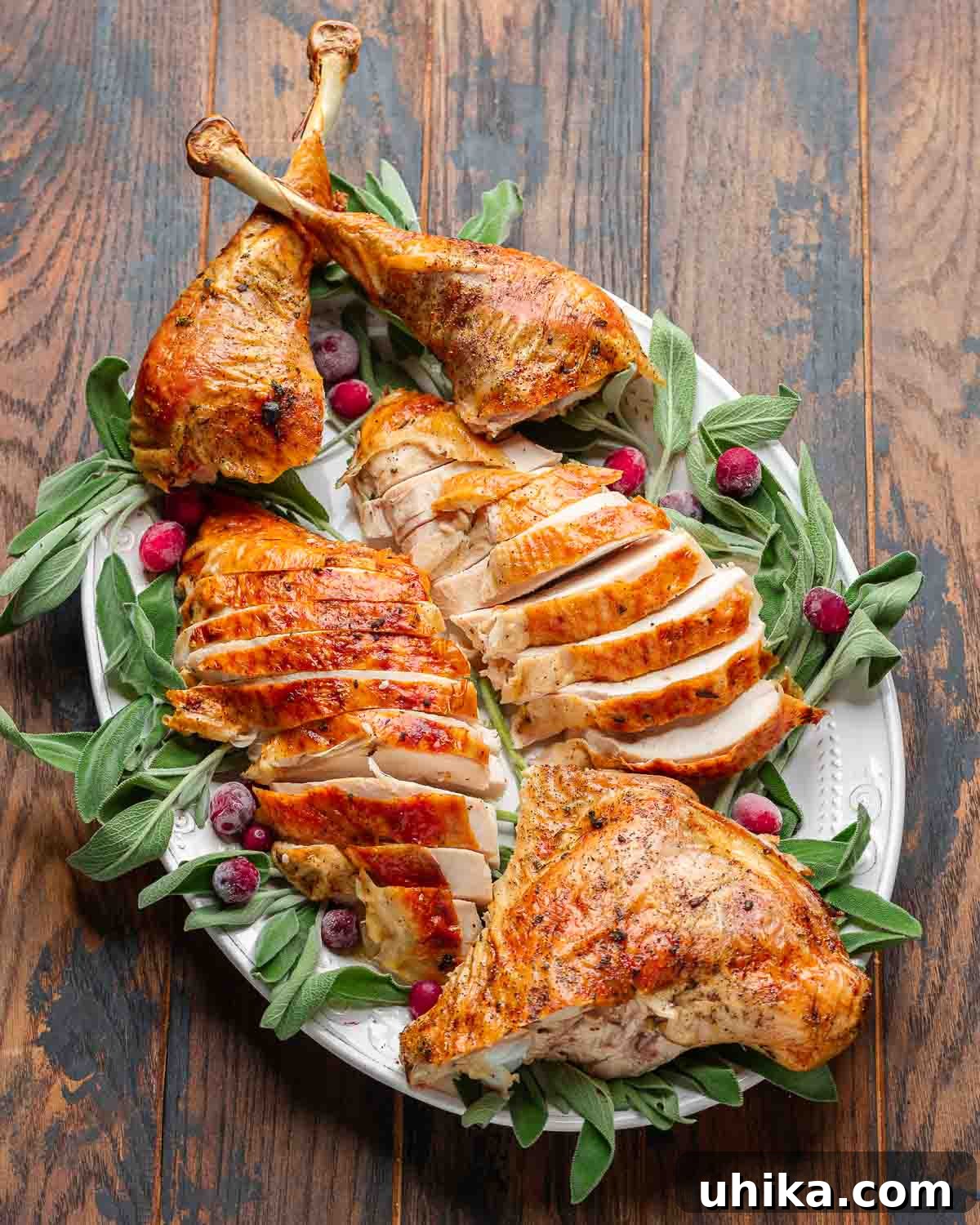
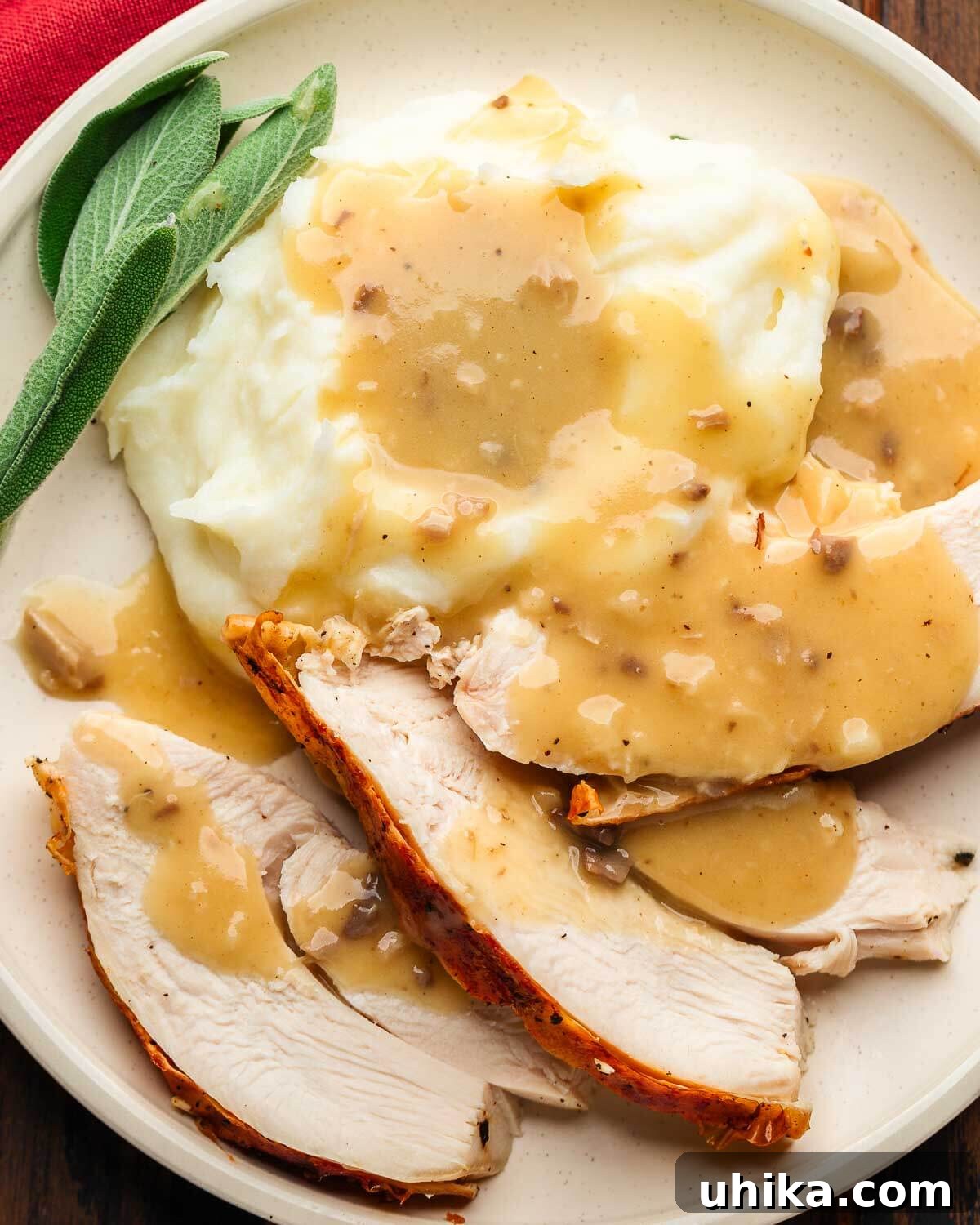
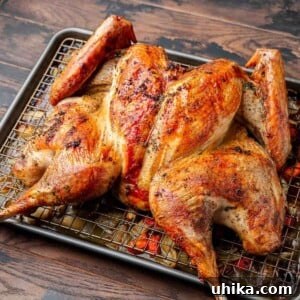
- Present and Enjoy: Slice the breast meat into even portions for elegant serving. Remember to save the flavorful vegetables, precious pan drippings, and the backbone from roasting; these are invaluable for creating a rich, homemade turkey gravy. Arrange the beautifully carved turkey on a large platter, alongside your delectable gravy and all your favorite holiday side dishes. Serve immediately and savor the triumph of a perfectly cooked spatchcock turkey! (See Photo #12 in the collage above, and a final plated image below)
Top Tips for Spatchcock Turkey Success
- Embrace the Dry Brine: Do not skip the dry brining process! While it requires a bit of foresight, this step is absolutely essential for producing a turkey that is incredibly juicy from edge to edge and boasts gorgeously browned, crispy skin. The salt in the brine denatures the proteins in the meat, helping them retain moisture during cooking. When purchasing your turkey, look for one that is labeled “natural” or “no salt added” to avoid over-salting, as many commercially processed turkeys are already injected with a brining solution. Avoid brining an already brined turkey.
- Optimize Dark Meat Doneness: While white meat (breast) is perfectly safe and delicious at 165°F (74°C), dark meat (thighs and legs) truly shines when cooked to a slightly higher temperature, ideally between 185-190°F (85-88°C). Achieving this simultaneously with white meat can be tricky without overcooking the breast. The beauty of spatchcocking is that it promotes more even cooking, so your dark meat might already be in this ideal range when the breast hits 150°F. Always check the temperature in the thickest part of the thigh with an instant-read thermometer. If after resting and carving, the dark meat hasn’t reached its optimal tenderness, you can separate the legs and thighs, return them to the oven for a short period, while keeping the white meat tented with foil to stay warm. If dark meat isn’t a favorite at your table, consider preparing a dry-brined turkey breast instead!
- Maximize Flavor with Giblets, Drippings, and Vegetables: Don’t let anything go to waste! The giblets, neck, backbone, roasted vegetables from the pan, and all those precious pan drippings are a treasure trove of flavor. These elements, combined with a few additional ingredients, are the foundation for the most incredible, rich, and savory giblet gravy you’ve ever tasted. Collecting these flavorful components ensures your holiday meal is complete with a truly homemade touch.
Frequently Asked Questions About Spatchcock Turkey
The most recommended and safest method for thawing a frozen turkey is in the refrigerator. A general guideline from the USDA is to allow approximately 1 day of thawing time for every 4-5 pounds of turkey. Therefore, a 12-pound turkey will require roughly 3 days to thaw completely in the refrigerator. Once fully thawed, the turkey should be cooked within 2 days to ensure freshness and safety.
A good rule of thumb when planning your holiday meal is to estimate between 1 to 1 1/2 pounds of turkey per person. This calculation accounts for bone weight and ensures there’s enough meat for everyone, with a little extra for leftovers (which are always a holiday bonus!). So, if you’re hosting 10 guests, a 12-pound turkey should be the perfect size, providing generous portions.
More Thanksgiving Favorites to Complete Your Feast
No holiday meal is complete without an array of delectable side dishes and desserts. Here are some of our top Thanksgiving favorites that perfectly complement a roast spatchcock turkey:
- Roasted Brussels Sprouts and Carrots – A simple yet elegant side that’s bursting with flavor.
- Italian Sausage Stuffing – A savory, hearty stuffing elevated with rich Parmigiano Reggiano cheese.
- Mashed Potatoes – Creamy, dreamy mashed potatoes infused with the subtle sweetness of roasted garlic.
- Thanksgiving Sangria – A festive and refreshing white wine sangria featuring seasonal apples and pears.
- Pumpkin Pie – A classic pumpkin pie, reinvented with an amaretti cookie crust and luxurious amaretto whipped cream.
- Apple Crostata – This rustic, free-form apple tart is wonderfully flavorful and surprisingly easier to make than a traditional pie!
If you’ve thoroughly enjoyed this Spatchcock Turkey recipe or any other recipe on our site, please consider giving it a 5-star rating and sharing your experience in the comments section below.
We believe in catering to various learning styles. If you are someone who prefers visual learning, you can find most of our recipes and cooking demonstrations on our YouTube channel and our Facebook Page.
Spatchcock Turkey
by James Delmage
Rated 4.91 out of 5 stars based on 33 votes.
Prep Time: 20 minutes
Cook Time: 1 hour 20 minutes
Dry Brine Time: 1 day
Total Time: 1 day 2 hours 10 minutes
Servings: 10
Pin Recipe
This spatchcock Turkey recipe yields the juiciest, flavor-packed turkey and the crispiest skin in only a fraction of the time! A must for those in need of extra time around the holidays!
Ingredients
For the brine
- 1 12-pound natural or organic turkey (no salt added) – see notes below
- 6 tablespoons Diamond Crystal Kosher salt – or 4 tablespoons Morton’s kosher salt
Remaining ingredients
- 2 large carrots, chopped
- 3 ribs celery, chopped
- 2 large onions, chopped
- 2 teaspoons black pepper
For the herb butter
- 1 tablespoon thyme leaves
- 10 large sage leaves, minced
- 8 tablespoons unsalted butter, softened
Want To Save This Recipe?
Enter your email and we’ll send it to you. Plus, get great new recipes from us every week!
Instructions
Brining the turkey
- Place the turkey on a large cutting board, breast side down and with the tail side facing you. Pat it dry with paper towels.
- Using kitchen shears, begin cutting from the tail end on one side of the backbone all the way to the neck. Repeat the same cut on the other side of the backbone. You can cut away any loose overhanging skin by the neck opening. Save the backbone for gravy or stock.
- Flip the turkey over and with two hands press the breast bone down until the turkey is splayed or flattened. You should hear a couple of cracks during this process. The goal is to flatten the turkey for even cooking.
- Place the turkey on a baking sheet and sprinkle the salt all over the bird on both sides and underneath parts of the skin if possible. Don’t worry about using every bit of the salt, just make sure to cover the bird in all areas. Refrigerate overnight uncovered.
Roasting the turkey
- Remove the turkey 1 hour before roasting. Preheat the oven to 450°F (232°C) and set the rack to the middle level.
- Mix the butter with the thyme and sage to form a paste.
- Place all of the vegetables on a baking sheet and then place a wire rack on top of them.
- Dry off the turkey with paper towels and season with pepper. Place the turkey on top of the baking sheet/wire rack and tuck the wings underneath to prevent burning. Spread the herb butter on top and underneath the skin.
- Place a probe into the thickest part of the breast and set the alarm to go off at 150°F (66°C). Roast turkey, rotating the pan 180 degrees at halfway point.
- Once the alarm goes off, remove it from the oven and let rest for 30 minutes before carving. See notes below for more info on optimally cooking dark meat.
- The vegetables, drippings, and backbone can be saved for making turkey gravy if desired. Enjoy!
Notes
- Cook the turkey until the breast reaches 150°F (66°C) and let rest until it reaches 165°F (74°C). Dark meat is best cooked to 185-190°F (85-88°C) but that is hard to achieve without overcooking the white meat. If desired, after carving, place the dark meat back into the oven and cook until 185°F while tenting the white meat with foil to keep warm.
- Only dry brine the turkey if it is a natural, no-salt-added turkey. Many turkeys are sold in a brined solution so pay attention to not oversalt the turkey.
- Brine at a 1-1.25% ratio of salt to turkey weight for a delicious but not overly salty bird. A 12-pound turkey weighs 5448 grams so it needs 54-68 grams of salt which equals roughly 2 3/4-3 1/2 tablespoons of table salt. When using kosher salt you will need to use more tablespoons because a tablespoon of kosher salt weighs less than a tablespoon of table salt. See table below:
- 1 Tablespoon of Table salt = ~19 grams
- 1 Tablespoon Morton kosher salt = ~15 grams
- 1 Tablespoon Diamond Crystal kosher salt = ~10 grams
- Leftovers can be saved for up to 3 days in the fridge.
- For larger turkeys that may overhang a standard baking sheet, line the bottom rack of the oven with foil to catch any butter and drippings and help prevent smoking.
Nutrition
Calories: 506kcal | Protein: 61g | Fat: 18.1g | Saturated Fat: 8.3g | Cholesterol: 178mg | Sodium: 2072mg | Potassium: 623mg | Calcium: 9mg | Iron: 21mg
Nutrition information is automatically calculated, so should only be used as an approximation.
Like this? Leave a comment below! Check us out on Instagram at @sipandfeast or tag #sipandfeast!